What is the Holy Trinity of Cajun Cooking?

Key Takeaways
- The Holy Trinity — onion, bell pepper, and celery — is the flavor foundation of Cajun cooking.
- Master the ratio (2:1:1) and the technique, and you'll have a base that elevates everything from gumbo to grilled chicken.
- The grill version, done in a cast-iron skillet with smoked sausage, might be the best version of all.
Diced Onion, Bell Pepper, and Celery
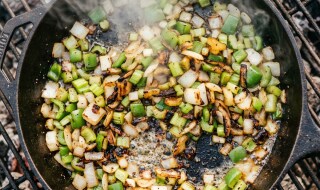
Being from Cincinnati and moving to Louisiana, I learned real quick that Cajun cooking starts with three things: diced onion, bell pepper, and celery. Down here, that's the Holy Trinity, — and once it hits a hot skillet, the whole neighborhood knows somebody is cooking.
It sounds simple. It is simple. But simple and easy aren't the same thing. There's technique here, and understanding it will change how you cook.
Why It's Called the Holy Trinity
Every great cuisine has a foundational flavor base. French cooking has mirepoix — onion, carrot, celery. Spanish has sofrito. In Cajun and Creole cooking, that base is the Holy Trinity: onion, bell pepper, and celery.
The name is a nod to Louisiana's deep Catholic roots, and like most things in Louisiana, it's not just a metaphor.
These three vegetables aren't interchangeable, and the ratio matters. The sweetness of onion does different work than the brightness of bell pepper or the subtle earthiness of celery. Together, cooked low and slow in fat, they build a savory base that goes underneath almost everything — gumbo, jambalaya, étouffée, red beans, dirty rice, and more.
When you cook them right, they don't taste like three vegetables anymore. They taste like one thing. That's the point.
The Ratio and How to Build It
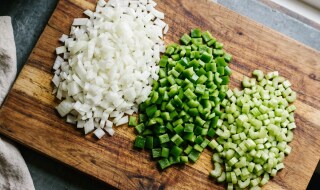
Use two parts onion, one part bell pepper, one part celery.
For a basic batch, that's one medium onion, one medium bell pepper, and two stalks of celery, which is roughly a 2:1:1 ratio by volume.
Dice everything into pieces of similar size so they cook evenly. Smaller dice means faster cook time and a finer texture; a larger dice gives you more presence in the finished dish.
Cook in butter or oil over medium heat. This is not a high-heat step. You're not searing. You're softening and coaxing flavor out. Give it 8–10 minutes, stirring occasionally, until everything is translucent, tender, and smelling the way it should. The onions will lose their sharpness. The bell pepper will sweeten. The celery will mellow. At that point, you have a base.
From there, you can add garlic (always), Cajun seasoning, tomato paste, stock, proteins, or whatever the dish calls for. But the Trinity comes first.
Expert Tip

Around here, good cooking doesn’t need a bunch of fancy talk. Give me some onion, bell pepper, celery, a hot cast-iron skillet, and a smoking grill. Let that Holy Trinity cook down slow, and you’re halfway to something worth pulling up a chair for.
The BBQ Version of The Holy Trinity
Here's where it gets fun.
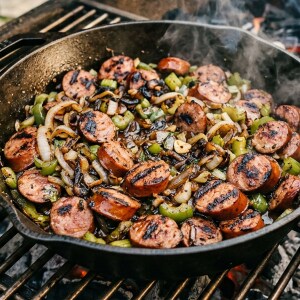
Take the Trinity outside to the grill, and you add smoke and char to the equation — which is like getting a bonus ingredient for free.
My go-to: Get a cast-iron skillet hot on the grill. Add butter, let it melt, then add your diced Trinity with a few cloves of minced garlic and a generous hit of Cajun seasoning. While that starts to soften, slice up some smoked sausage — (andouille if you can get it) — and add it to the skillet.
Now leave it alone for a few minutes. Let the bottom of the sausage get a little char. Let the vegetables do their thing with the fat and the smoke circulating around the skillet. Give it a stir, let it ride another few minutes, and you'll end up with something that tastes like it's been cooking all afternoon.
Pile it over grilled chicken thighs, burgers, pork chops, or baked potatoes cooked right on the grill grates. Spoon it into a bowl over rice. Or just stand over the skillet with a fork.
No judgment here.
What It Unlocks
Once you understand the Trinity, a lot of Cajun and Creole recipes suddenly make sense. It shows up in almost all of them because it works in almost all of them.
But more than that, it teaches a principle that applies everywhere in cooking: Flavor starts at the foundation.
You don't build a great gumbo by adding more seasoning at the end. You build it by treating those first three ingredients right.
Cincinnati taught me comfort food. Louisiana taught me how to build flavor from the bottom up.
Three vegetables, one hot grill, and a whole lot of attitude. Bon Appétit!
Comments
0 comments
Please sign in to leave a comment.