Does Your Outdoor Kitchen Need a Built-in Griddle?

Quick Answer
- A built-in gas griddle is worth it if you often cook flat-top food like breakfast, smash burgers, fajitas, or hibachi-style meals, and your island has room for it without sacrificing grill or prep space.
- If you only griddle a few times a year, a freestanding griddle or a griddle plate for your existing grill will probably cover you.
- If you build one in, settle the fuel type, gas line capacity, and island safety (insulated jacket and vent panels) before the island is framed and finished.
The griddle has had a big few years. Freestanding propane flat tops went from tailgate gear to a backyard staple almost overnight, and now I’m hearing a new question from people planning outdoor kitchens: “Should I just build one in?”
Sometimes the answer is an easy yes. But a built-in gas griddle is a different kind of commitment than a griddle on a cart. It takes up counter space for good, needs a gas connection, and comes with a few decisions you have to make before your island is finished. Here’s how I’d think it through.
Why Built-In Griddles Are Having a Moment
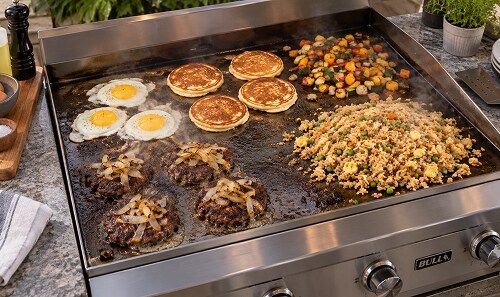
Built-in flat tops aren’t actually new. High-end outdoor kitchens have had them for years. What changed is demand. Once people got a taste of cooking breakfast for a crowd or turning out a dozen smash burgers at once, plenty of them decided they wanted that every weekend, without rolling a cart out of the garage or swapping a propane tank mid-cook.
A built-in gas griddle gives that cooking style a permanent home. It sits flush in the island, goes with the rest of your stainless, and shares counter space with your grill. If your home has natural gas, you never have to worry about running out of a tank.
It’s a Great Fit If…
- You cook for groups. A griddle’s big, even surface is built for volume, whether that’s pancakes for the whole family or fajitas for the neighborhood.
- You cook food that hates grates. Eggs, diced vegetables, fried rice, and delicate fish are easy on a flat top and frustrating on a grill.
- You already griddle a lot. If you use your freestanding griddle every week, building one in is less a new habit than a permanent upgrade to what you already have.
- You have island length to spare. A griddle needs counter space on both sides, just like a grill does.
You Might Skip It If…
- You griddle a few times a year. A freestanding griddle, or a griddle plate that fits your grill, gives you the same food without sacrificing permanent island space.
- Your island is already tight. If adding a griddle means a smaller grill or no room to set down a sheet pan, you’ve traded something you use every cook for something you use sometimes.
- You’re mostly a smoke-and-sear cook. If low-and-slow and steaks are your thing, put that budget toward a better grill, a smoker, or a side burner instead.
Make These Decisions Before the Island Is Built
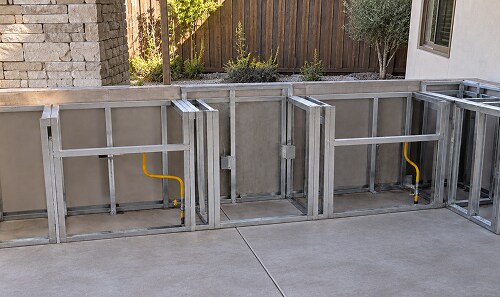
This is where built-in griddles catch people off guard. A freestanding griddle can be swapped or moved any time. A built-in one is locked in once the countertop goes on, so you need to make these decisions while the island is still a frame.
- Natural gas or propane. Built-in gas griddles are typically configured for one fuel type, and conversion options vary by model. Know which fuel you’ll use before you order, and check whether a conversion kit exists if you plan to switch later.
- Gas line capacity. Your griddle, grill, and side burner may all draw from the same line. If that line isn’t sized for everything running at once, every burner can run weak at exactly the wrong moment. Have a licensed gas professional size the line for the total demand of every appliance in the island.
- Island construction. If your island is framed with combustible materials, your griddle’s installation manual may call for an insulated jacket. Island vent panels matter, too: propane is heavier than air and settles low, while natural gas rises, so vent placement depends on your fuel.
- Grease management. Griddles produce a lot more grease than grills. Know where the grease tray sits, how you’ll reach it to empty it, and whether your model has a lid or cover to protect the cooktop between cooks.
- Covered kitchens. Griddle cooking throws off plenty of greasy smoke. If your kitchen is under a roof, size your vent hood for the griddle as well as the grill.
I asked Jade Nunez, who supervises our Design Services team, what she tells her customers who are considering a griddle in their outdoor kitchen.
Expert Tip
“One thing we emphasize during the design process is thinking through how all the cooking appliances will work together from the beginning. When incorporating a griddle, consider more than just the space it occupies. We need to account for the overall island dimensions, proper ventilation based on the fuel type, and adequate functional space around the cooking appliances. By planning for these details early, we can create a layout where the grill and griddle complement one another while maintaining functionality, workspace, and a natural flow throughout the outdoor kitchen.”
-- Jade Nunez
Where It Goes in the Layout
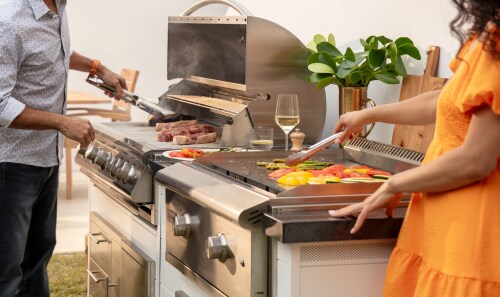
Most people put the griddle right next to the grill, and for good reason: it lets one cook run both, and it keeps all the hot work in one zone. Just make sure there’s counter space between and beside them so you have somewhere to land a tray of burgers or a bowl of chopped onions.
If two people regularly cook at the same time, give each appliance its own elbow room and think about where the second cook will stand. Keep the griddle close to your prep area and cold storage, because griddle cooking moves fast and involves a lot of ingredients at once.
The Bottom Line
If you already love flat-top cooking, a built-in gas griddle is the upgrade that turns it from an accessory parked beside your kitchen into part of the kitchen itself. If you only griddle now and then, there’s no shame in keeping it on a cart. Either way, if a built-in is on your wish list, bring it up early. The best time to plan for a griddle is before the island has a countertop.
Comments
0 comments
Please sign in to leave a comment.